|
|
|
|
Eating Implements
Apart
from the fact the same foods are often called very different things, the
style of eating between British English speakers and Americans differs
vastly.
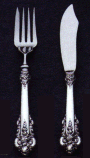
In the Commonwealth, one does NOT eat with just a fork… The knife
remains in the right hand and the fork in the left. In the USA the knife
is used to cut up the meat, after that, the knife is returned to the
table, the fork placed in the right hand and the rest of the meal
consumed with a fork only. In fact many meals such as salads are served
with only a fork, very confusing for people used to using both
implements for all meals.
In the Commonwealth the fork is held upside down, and food pushed onto
the bottom side of the fork - which is now curving downwards (I know
this doesn't make sense, but that's just the way it is!!) |
|
Chips or fries...
In
the Commonwealth French Fries (chips) are eaten with a knife and fork and
NOT one's fingers - except perhaps in a pub or fast food outlet..
Americans always use their fingers for fries even in up market
restaurants. And while on the subject of chips or fries - in the USA chips
are always called fries unless they are served with battered fish, then
and then only, are they called "fish and chips" - go figure THAT one out!! |
 |
|
 |
And then there were
hamburgers...
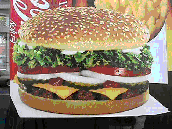
Hamburgers
in America are eaten whole with one's hands. In some Commonwealth
countries, it would
not be unusual for a diner to remove the top half of the bun and eat the balance of the hamburger
with a
knife and fork. This is not so much at a fast food place such as McDonalds,
but more you would see this at a fancier restaurant that serves burgers.
The barbecue
Most
Americans when it comes to a barbecue, cook on propane grills, while most
Commonwealthers cook on charcoal. Hamburgers and hot dogs are cooked
more often than other meats in America.
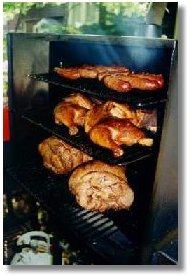
Smoking Meats
There is group of Americans that are more purists, who consider
barbecue to be slow cooked meat with usually a BBQ sauce. The meat usually cooked is pork such as ribs
or shoulder or chicken or beef. The barbecue purists tend shun gas in favor
of charcoal. |
|
Fish and Chips
Very common in the UK, fish and
chips are bought from "chippies" and eaten out of the paper with your hands.
There is a chippy in every village sometimes 2 or 3!
Breakfast
A
continental breakfast in the Commonwealth would be fruits, cheeses, a
variety of pastries and cold meats such as sliced ham. In the USA a
continental breakfast is coffee and donuts/pastries!
|

|
Beverages
Americans
take their coffee VERY seriously and the thought of drinking instant
coffee is about as appetizing as drinking toxic waste! Few US homes have
electric kettles, while no home is without
a coffee filter machine. In the Commonwealth, instant coffee is more
common than it's filtered version and regarded as quite acceptable and
would not raise eyebrows when served to guests.
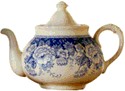
Tea,
on the other hand, in the Commonwealth is a hot drink served with sugar
and milk and is a daily staple. Tea in America is drunk cold with ice and
sugar (ugh!!). The only warm tea Americans drink is
herbal tea (which incidentally they pronounce: 'erbal).
Tea time (approx. 11am and
then again 3pm) is still observed in the Commonwealth. Tea and snacks
such a biscuits or scones are served. Coffee and other drinks are also
served these days. |
 |
|
Throw away stuff
Americans
truly have a "throw away" society. Even the best hotels will
sometimes serve coffee in disposable cups and the teaspoons are no more than plastic
straws. Restaurants however will serve coffee in mugs. Certainly saucers are NEVER provided. In the Commonwealth only fast-food outlets
use styrofoam (polystyrene) and plastic silverware (cutlery).
Americans
by the large do not use chop sticks at Chinese restaurants. Most Chinese
restaurants automatically provide forks or spoons on the table and chop
sticks have to be ASKED for. The reverse is the case in the Commonwealth
where spoons and forks are only provided on request. |
|
The speed with which we eat...
American
restaurants are almost without exception "eat, pay and get outta
here" establishments. A table would be typically turned over 5 or 6
times in an evening. Starters (appetizers) are rushed out within 5-10
minutes of arrival and the main course is served immediately. The check is
brought as soon as the plates are cleared. An average visit to an American
restaurant is between 45 minutes and an hour. Once again this is a
generalization, there ARE exceptions to this rule, so don't go writing
nasty e-mails to me!!
In the
Commonwealth a group of friends going to a restaurant will invariably be
there for the entire evening. A stay of 2-4 hours in the restaurant would
not be considered unusual. Main courses can be held back until the party
calls for them - there could be as much as an hour break between courses.
Once the meal is complete the check is seldom brought until the guests ask
for it. Which could be a few hours later as the party will continue to
sit, drink and socialize at the table, sometimes until the wee hours.
|

|
|
Tipping...
In the Commonwealth it is normal to tip your server 10%. In the USA 15% is
the norm and 20% in large cities such as New York. In Australia tipping is
not the norm at all.
Substitution...
In the USA you almost ALWAYS
change or substitute items on the menu. This a is very acceptable and a
common practice. IN the Commonwealth it is VERY unacceptable to change
anything out on the menu and apart from being frowned on, most of the
time your request will be refused.
Dress
Dress in most restaurants in
the USA is casual with shorts and T-shirts being the norm. In
Commonwealth countries dress code is a little more formal such as smart
casual except in bars and street cafes. |
|
And the times we eat... Eating
times differ greatly!! Americans prefer eating early in the evening and
often will be found in restaurants having dinner at 5 p.m. In the
Commonwealth restaurants only open their kitchens at 6 p.m. with most
people only reserving tables from 7.30 - 9.00 p.m. Many USA restaurants all
close by 10 p.m. In the Commonwealth it is not uncommon to be still in a
restaurant past midnight! Lunchtime in the USA is 12 noon and in the
Commonwealth it is 1 p.m.
|
|